
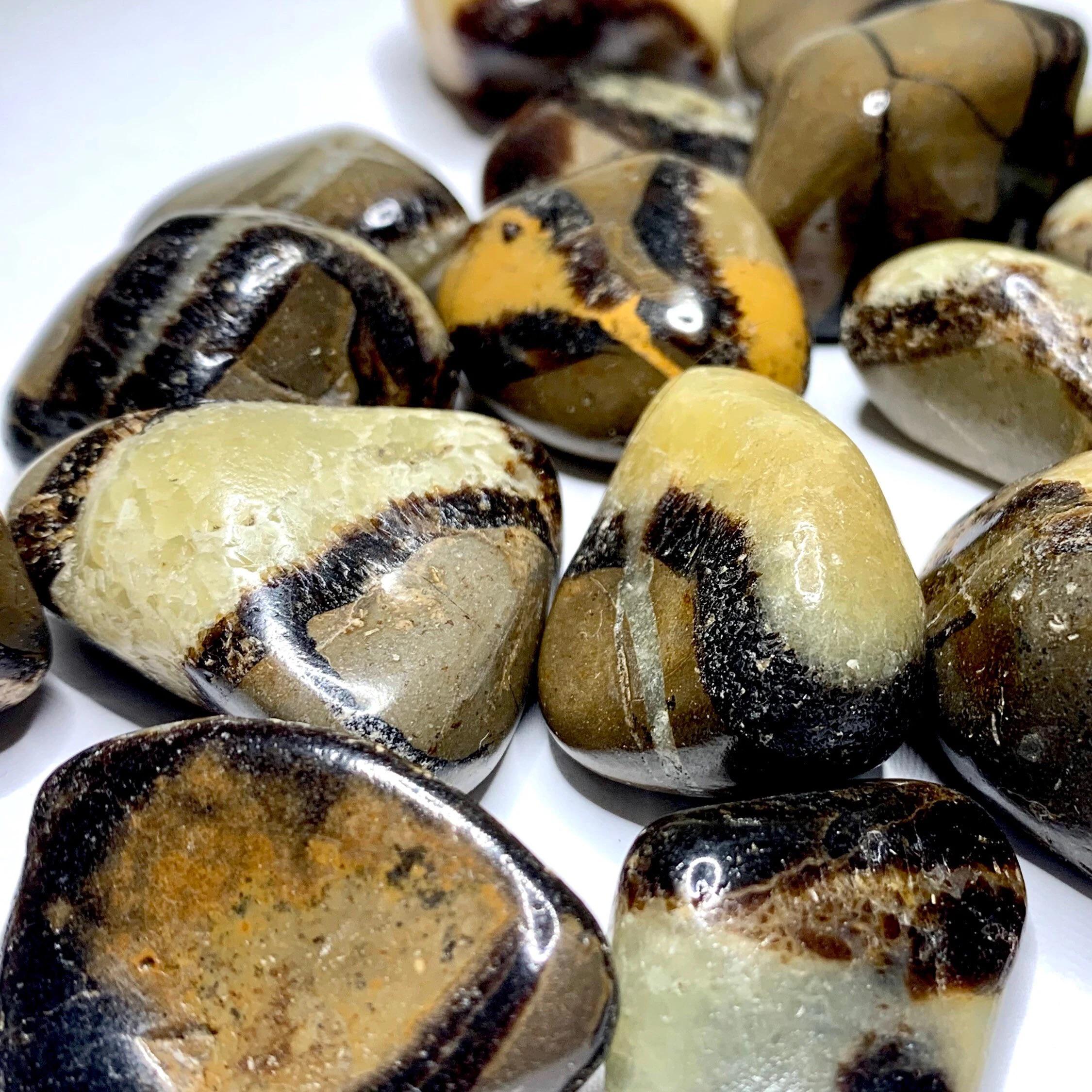
Septarian crystal, or "Dragon Stone," is a unique, 50-70 million-year-old nodule composed of yellow Calcite, brown Aragonite, and grey Limestone, often featuring drusy crystals and internal cracks.
Formed during the Cretaceous Period from decomposed sea life and volcanic sediment, these stones are primarily found in Utah and Madagascar.
Key Characteristics & Properties
- Appearance: Known for a "dragon skin" pattern, these rounded nodules feature dramatic, web-like cracks, often filled with calcite or aragonite.
- Mineral Composition: Composed of Limestone (outer layer), Aragonite (brown lines), and Calcite (yellow center).
- Formation: Sedimentary concretions formed when volcanic eruptions killed sea life, which sank into sediment, creating mud balls that dried, cracked, and filled with calcite over millions of years.
- Hardness: ~3.5-4.0 on the Mohs scale.
- Locations: Major sources include Utah (often brighter, honey-yellow calcite) and Madagascar (often featuring black, white, or dark brown combinations).
Metaphysical and Uses
- Properties: Considered a calming, grounding stone, it is believed to help with stress reduction and emotional balance.
- Usage: Frequently used in meditation and as decorative, polished specimens to connect with Earth energy.
- Nickname: Often called "Dragon Stone" due to its scaly, segmented appearance.
Types of Septarian
- Utah Septarian: Known for high-contrast yellow calcite, often mined in the Zion National Park area.
- Madagascar Septarian: Often features stark black and brown patterns, sometimes including fossils.
Septarian is not a single mineral but a complex mixture of minerals and sedimentary rock that forms a "geode-like" nodule.
Check some Septarian Crystal here:
https://www.etsy.com/shop/EarthsMineralsInc?ref=seller-platform-mcnav&search_query=septarian
Carla - E.M.I.